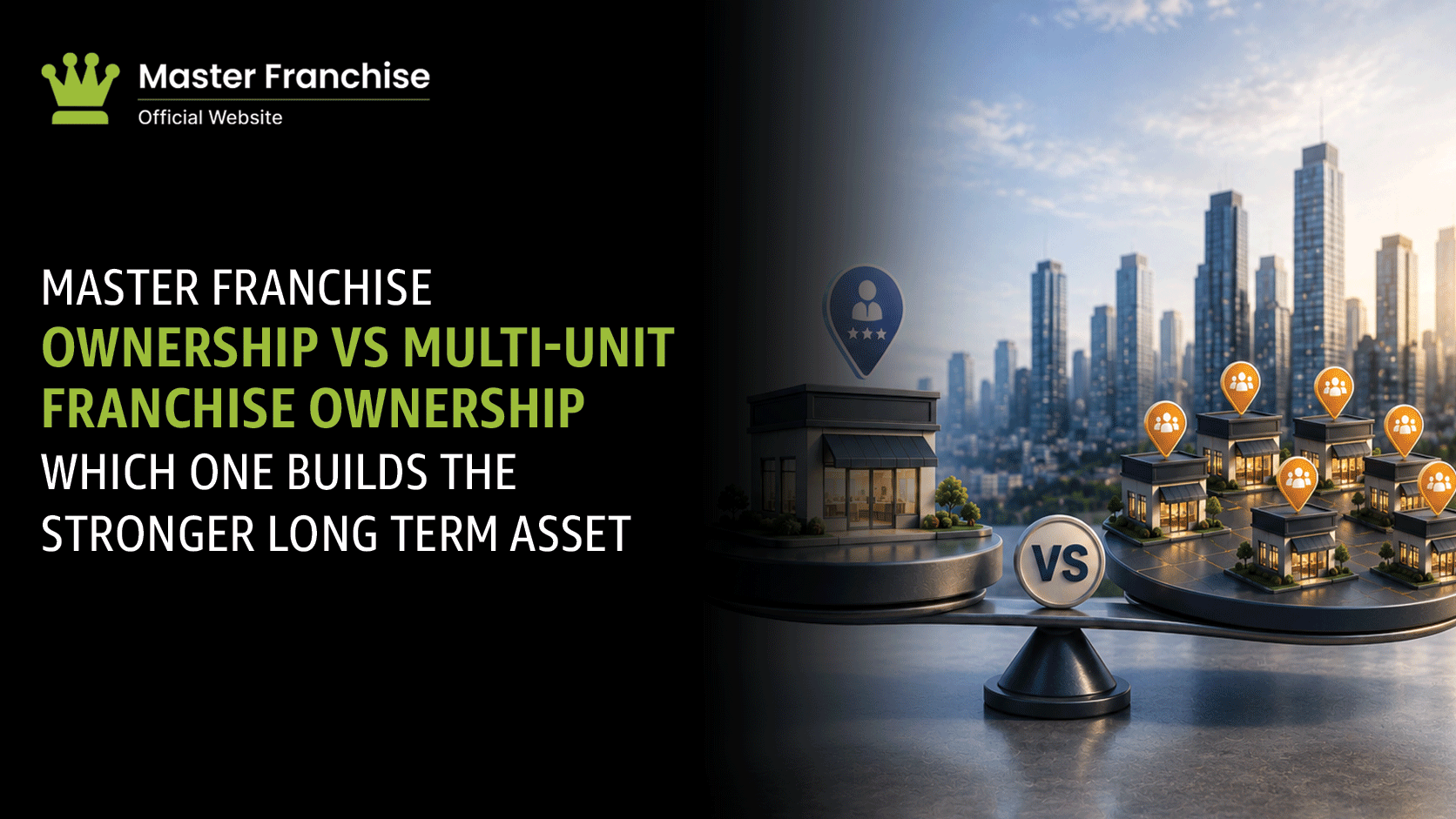
As franchise investors move beyond single-unit ownership, the conversation almost always narrows to two models:
Multi-Unit Franchise Ownership
Master Franchise (Area Developer) Ownership
While each have their own benefits of scale, higher income, and equity appreciation, they’re not the same in terms of how they scale, how they exit, or how they operate. It will depend on whether you need to run the operation or whether you are looking at developing regional leverage.
Let’s look at the difference between these two models in detail.
Table of Contents
1. What Is Multi-Unit Franchise Ownership?
Multi-unit franchisees own and operate several outlets for the same brand.
- You invest capital into each unit
- You hire managers and staff
- You oversee daily operations across locations
- You earn profits from each unit
This structure is common in food, fitness, retail, and home services.
Strong operators with an interest in execution, team management and operational control will enjoy multi-unit ownership.
2. What Is Master Franchise Ownership?
Master Franchise owners control a defined territory rather than operating locations themselves.
In this model:
- You secure exclusive regional or statewide rights
- You recruit and support franchisees
- Franchisees fund and operate their own units
- You receive franchise fees and ongoing royalties from all sites
Your role is strategic, not operational. You function as a regional growth partner and brand steward.
3. Capital Requirements and Leverage
Capital for each new multi-unit location is needed. Growth is linear, meaning that it requires new investments, staffing and management
Master Franchising usually requires a higher initial territory fee, and the subsequent expansion is made up for by the franchisees. This means that you can leverage with other people’s money, which is something a multi-unit owner can’t do.
4. Operational Involvement
Multi-unit owners remain closely tied to operations:
- Staffing and payroll
- Scheduling
- Vendor management
- Performance oversight
Master Franchise owners focus on
- Territory development
- Franchisee recruitment
- Training and support
- Brand consistency
This makes Master Franchising a more semi-passive model once systems are in place.
5. Revenue Structure
Multi-Unit owners receive income from:
- Location-level profit
- Operational efficiency
- Cost control
Master Franchise owners earn from:
- Franchise fees
- Ongoing royalties
- Training and support income
- Long-term territory appreciation
Master Franchising provides multiple income streams instead of just unit profits.
Looking for Proven Master Franchise
Opportunities?
Explore established franchise brands and learn how
experienced master franchisees have successfully developed regional and international markets.
6. Scalability

The rate of multi-unit ownership is fairly slow and gradual. More units mean increased complexity in operation.
Master Franchise ownership grows by an exponential factor. This means that a single territory is capable of supporting multiple units, which will generate regular royalties without adding to the daily workload.
7. Risk Profile
Multi-unit ownership focuses the risk of operations, labour, leases and increases in costs.
- Franchisee performance
- Territory execution
- Brand growth
While both models carry risk, Master Franchising reduces exposure to daily operational volatility.
8. Exit Potential
Multi-unit businesses typically sell based on EBITDA and operational performance, often at moderate multiples.
Master Franchise territories are valued based on:
- Recurring royalty streams
- Territory size and saturation
- Growth runway
- Strategic value to larger buyers
This means that when a Master Franchise exits, the price is likely to be higher and more likely to be a private equity or strategic buyer.
9. Which Model Is Right for You?
Multi-unit ownership is ideal for investors who:
- Enjoy operations and team management
- Want hands-on control
- Prefer predictable unit-level income
Master Franchise ownership is ideal for investors who:
- Want regional scale
- Prefer leadership over daily management
- Value leverage and recurring revenue
- Are building a long-term asset rather than a job
FAQs
What is the difference between Master Franchise ownership and multi-unit franchise ownership?
Master franchise owners develop a territory. While multi-unit owners operate multiple franchise units.
Which franchise model offers greater scalability?
Territory expansion and franchisee growth are the usual ways for master franchise ownership to scale up.
How do Master Franchise owners earn revenue?
They can earn money from the franchise fees, regular royalties and the regional development rights.
Is Master Franchise ownership more hands-off than multi-unit ownership?
Yes, Master Franchise owners invest their time in territory building and support of their franchises instead of running the franchise daily.
Which franchise model is better for long-term wealth creation?
The advantages of master franchise agreements lie in the potential for scaling up assets across a region, generating recurring revenue and with improved exit prospects.
Conclusion
Both models can build wealth, but they build different kinds of businesses.
Multi-unit ownership creates strong operating companies. Master Franchising is a mechanism to develop regional platforms that are leveraged, scalable and strategically valuable.
The highest performing investors select the model that suits their working style now and their asset of the future.
Explore Master Franchise
Opportunities
Connect with franchisors seeking experienced master
franchise partners for international and regional territory development.