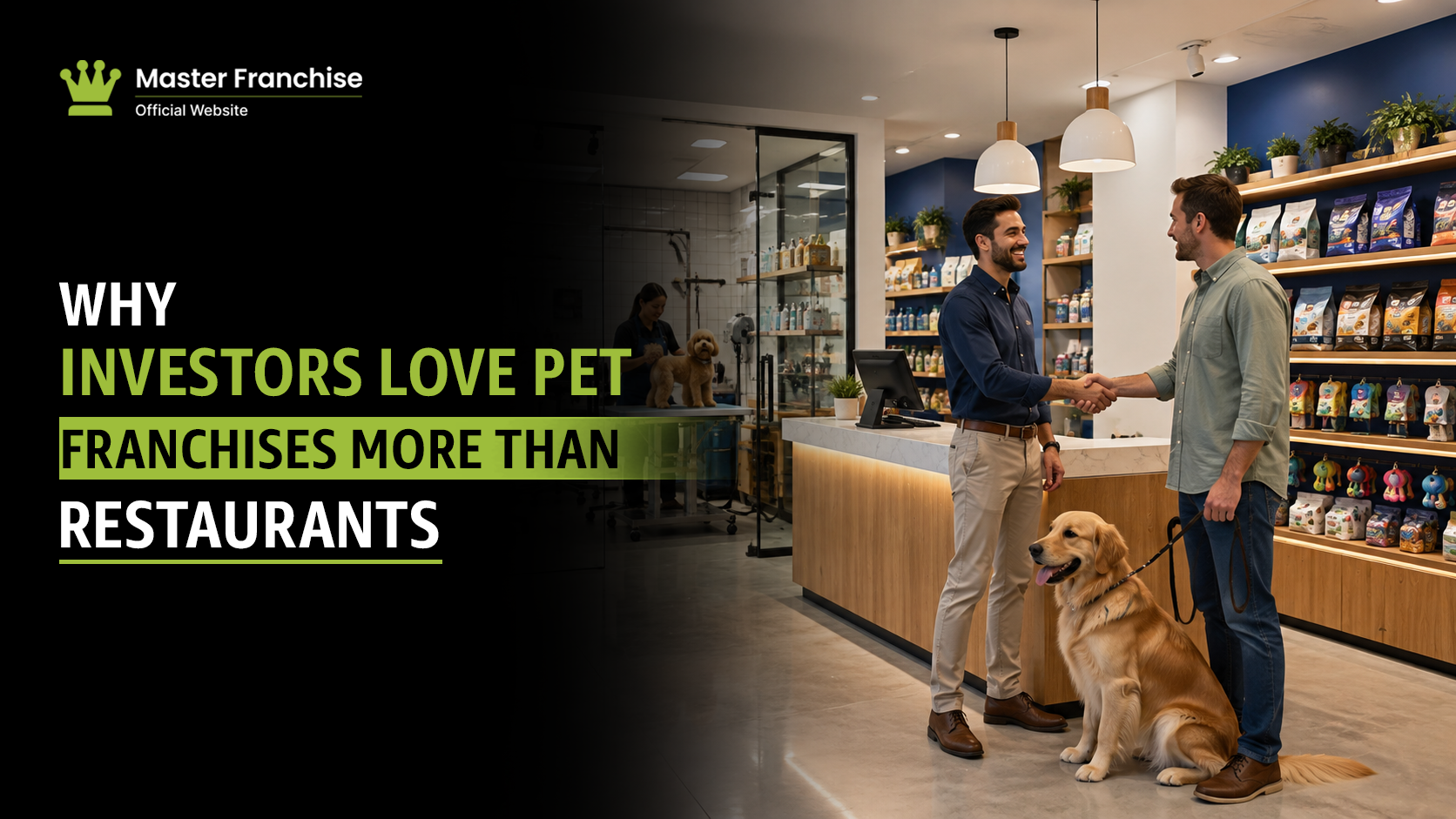
Restaurants will always attract entrepreneurs.
But when it comes to serious investors, especially those focused on scalability, predictability, and long-term returns, pet franchises are quietly becoming the preferred category.
The reason is simple: pet businesses often offer stronger unit economics, more stable demand, and less operational volatility than food concepts.
Here’s why investors increasingly choose pet franchises over restaurants.
Table of Contents
- Pet Spending Is Emotional, Not Optional
- Pet Services Are Recurring by Nature
- Restaurants Have Thin Margins and High Fragility
- Operational Complexity Is Lower in Pet Franchises
- Pet Franchises Offer Stronger Multi-Unit Scalability
- Better Reviews, Stronger Word-of-Mouth
- Less Vulnerability to Trend Cycles
- Easier to Build Territory Dominance
- Frequently Asked Questions
1. Pet Spending Is Emotional, Not Optional
Restaurant spending is discretionary. It’s influenced by:
- inflation
- consumer confidence
- lifestyle shifts
- competition and convenience
Pet spending is different.
For many households, pets are treated like family. That emotional bond creates spending behavior that’s more consistent, even during uncertain economic cycles.
Investors like categories where demand doesn’t disappear overnight.
2. Pet Services Are Recurring by Nature
Restaurants rely on constant re-acquisition:
- new customers every day
- repeat visits that are hard to predict
- heavy promotions to drive traffic
Pet franchises often operate on recurring need:
- grooming every 4-8 weeks
- daycare weekly or daily
- boarding during travel
- subscriptions and wellness add-ons
Recurring demand increases lifetime value and makes forecasting easier, two things investors prioritize.
3. Restaurants Have Thin Margins and High Fragility

Food businesses carry structural challenges:
- food costs fluctuate
- labor costs are unstable
- waste and spoilage
- constant staffing pressure
- high customer churn
Even strong restaurants can struggle with margin compression.
Pet franchises, especially service-focused models, often have more stable cost structures, less inventory risk, and better ability to maintain pricing.
Looking for Proven Master Franchise
Opportunities?
Explore established franchise brands and learn how
experienced master franchisees have successfully developed regional and international markets.
4. Operational Complexity Is Lower in Pet Franchises
Restaurants are operationally intense:
- daily inventory management
- food safety compliance
- kitchen operations
- shift scheduling chaos
- peak-hour pressure
Pet franchises still need to have solid operations, but they don’t tend to change hands so much every day. There are many pet models that can be easily systemized and duplicated at various sites.
Businesses that can scale without breaking are more appealing to investors.
5. Pet Franchises Offer Stronger Multi-Unit Scalability
Multi-unit expansion is where real wealth is created in franchising.
Restaurants are scalable, but so are the complexities, the more locations the more there is. Staffing and quality control factors become significant risks.
Pet franchises often scale more smoothly because:
- services can be standardized
- appointments create predictability
- customer retention is higher
- local dominance is easier to build
This makes pet franchises attractive for:
- multi-unit owners
- area developers
- master franchise buyers
6. Better Reviews, Stronger Word-of-Mouth
Pet businesses naturally generate referrals.
When a customer finds a grooming team they trust, they tell others. Reviews tend to be stronger because the service is personal and emotionally connected.
Restaurants rely on:
- convenience
- novelty
- price
Pet businesses rely on trust and results. That creates deeper loyalty.
7. Less Vulnerability to Trend Cycles
Restaurant concepts can rise and fall quickly:
- trendy menus
- changing consumer tastes
- crowded categories
Pet services are less trend-driven. People don’t stop grooming their dog because a new competitor opens nearby. If trust is established, switching is harder.
That stability lowers risk, exactly what investors want.
8. Easier to Build Territory Dominance
Investors think in territories, not single stores.
Pet franchises can dominate local markets by building density:
- grooming + daycare + boarding
- multiple neighborhoods
- recurring client bases
- community partnerships
This creates a regional footprint that becomes a valuable asset, not just a location-based business.
FAQs
Restaurants will always be popular, but they’re one of the hardest franchise categories to scale profitably.
Pet franchises win with investors because they combine:
- emotional demand
- recurring services
- strong retention
- simpler operations
- scalable multi-unit potential
In today’s market, the smartest investors aren’t chasing the busiest kitchen.
They’re building recurring revenue in categories people won’t stop spending on, and pet franchising is one of the strongest plays available.
Explore Master Franchise
Opportunities
Connect with franchisors seeking experienced master
franchise partners for international and regional territory development.