Not all territories are created equal.
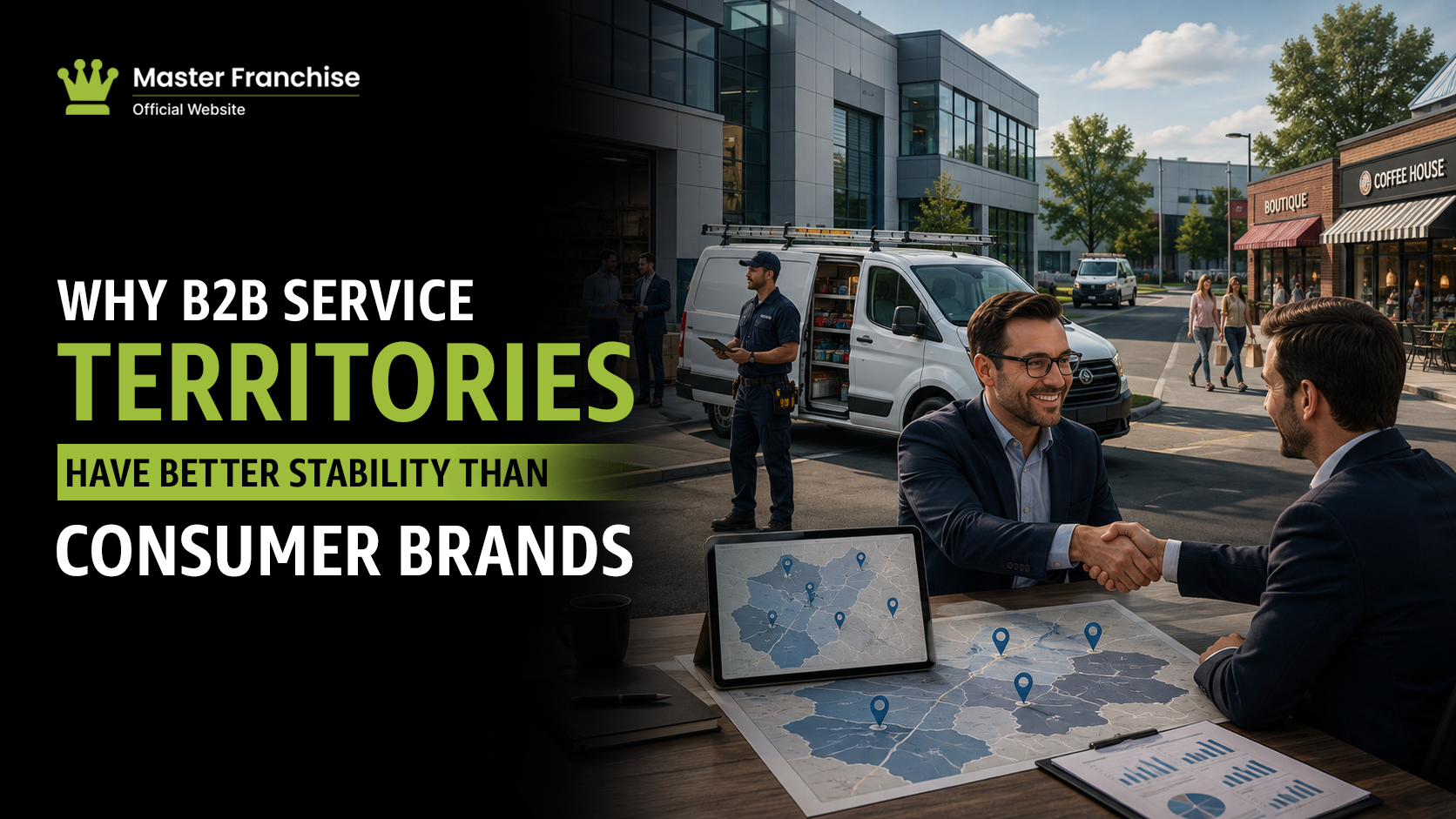
While consumer brands get more attention flashy marketing, big logos, social buzz B2B service territories quietly outperform when it comes to stability, predictability, and long-term value.
That’s why experienced investors, private operators, and territory buyers increasingly favor B2B service models over consumer-facing concepts.
Here’s why B2B service territories are structurally more stable, and what that means if you’re evaluating ownership or expansion.
Table of Contents
-
- B2B Demand Is Operational, Not Emotional
- Long-Term Contracts Reduce Revenue Volatility
- Switching Costs Are Higher in B2B
- B2B Pricing Is Less Sensitive to the Economy
- Fewer Customers, Larger Accounts
- Sales Are Slower—but Stickier
- B2B Territories Scale Cleanly Across Regions
- Buyers Pay More for Stability Than Excitement
1. B2B Demand Is Operational, Not Emotional
Consumer spending is emotional.
It fluctuates with:
- confidence
- trends
- disposable income
- seasonality
- lifestyle changes
B2B services, on the other hand, are operational
necessities.
Businesses must maintain:
- facilities
- compliance
- logistics
- cleanliness
- uptime
- safety
They don’t “feel like” buying these services. They need them to operate.
That alone creates a more stable demand curve.
2. Long-Term Contracts Reduce Revenue Volatility
Most B2B service territories operate on:
- monthly service agreements
- annual contracts
- multi-year renewals
This leads to:
- predictable recurring revenue
- clearer forecasting
- lower churn
- less dependency on constant marketing
Consumer brands often rely on daily or weekly purchase decisions. B2B territories rely on signed agreements.
Predictability beats popularity.
3. Switching Costs Are Higher in B2B

In consumer brands, switching is easy.
In B2B services, switching is painful.
Businesses hesitate to change vendors because it
means:
- onboarding risk
- service disruption
- retraining staff
- compliance exposure
- operational downtime
Once trust is established, B2B clients tend to stay.
That stickiness dramatically improves lifetime value and reduces churn risk.
4. B2B Pricing Is Less Sensitive to the Economy
Looking for Proven Master Franchise
Opportunities?
Explore established franchise brands and learn how
experienced master franchisees have successfully developed regional and international markets.
Consumers cut spending fast when the economy tightens.
Businesses adjust—but more slowly.
Why?
- services are budgeted
- costs are often passed through
- services protect revenue or reduce risk
- cutting core services creates bigger problems
As a result, B2B service territories experience less dramatic revenue swings during downturns.
5. Fewer Customers, Larger Accounts
Consumer brands rely on volume.
B2B service territories rely on account depth.
Benefits include:
- fewer transactions to manage
- higher average contract value
- simpler customer management
- clearer account-level profitability
Losing one consumer customer is noise. Losing one B2B account is visible but far less frequent.
6. Sales Are Slower—but Stickier
Yes, B2B sales cycles are longer.
But once closed:
- contracts last longer
- renewals are common
- upsells are easier
- referrals are higher quality
Consumer sales are faster but more fragile.
B2B sales trade speed for durability.
7. B2B Territories Scale Cleanly Across Regions
B2B services scale well because:
- offerings are standardized
- demand exists in every market
- contracts are replicable
- staffing is easier to forecast
- regional management is simpler
This is why industries like:
- commercial cleaning
- logistics and delivery
- facility services
- IT and managed services
- restoration and maintenance
are often built as territory-first businesses, not single-unit concepts.
8. Buyers Pay More for Stability Than Excitement
When it comes time to sell or expand, buyers prioritize:
- recurring contracts
- low churn
- predictable margins
- transferable operations
B2B service territories check these boxes consistently.
That’s why they often:
- trade at stronger multiples
- attract institutional buyers
- scale quietly but powerfully
FAQs
Conclusion
Consumer brands win attention.
B2B service territories win on stability.
With contract-based revenue, higher switching costs, predictable demand, and cleaner scaling, B2B service territories offer a level of resilience most consumer models can’t match.
For owners and investors who value:
- consistency over hype
- predictability over trends
- control over volatility
B2B service territories are one of the strongest ownership plays available.
Explore Master Franchise
Opportunities
Connect with franchisors seeking experienced master
franchise partners for international and regional territory development.