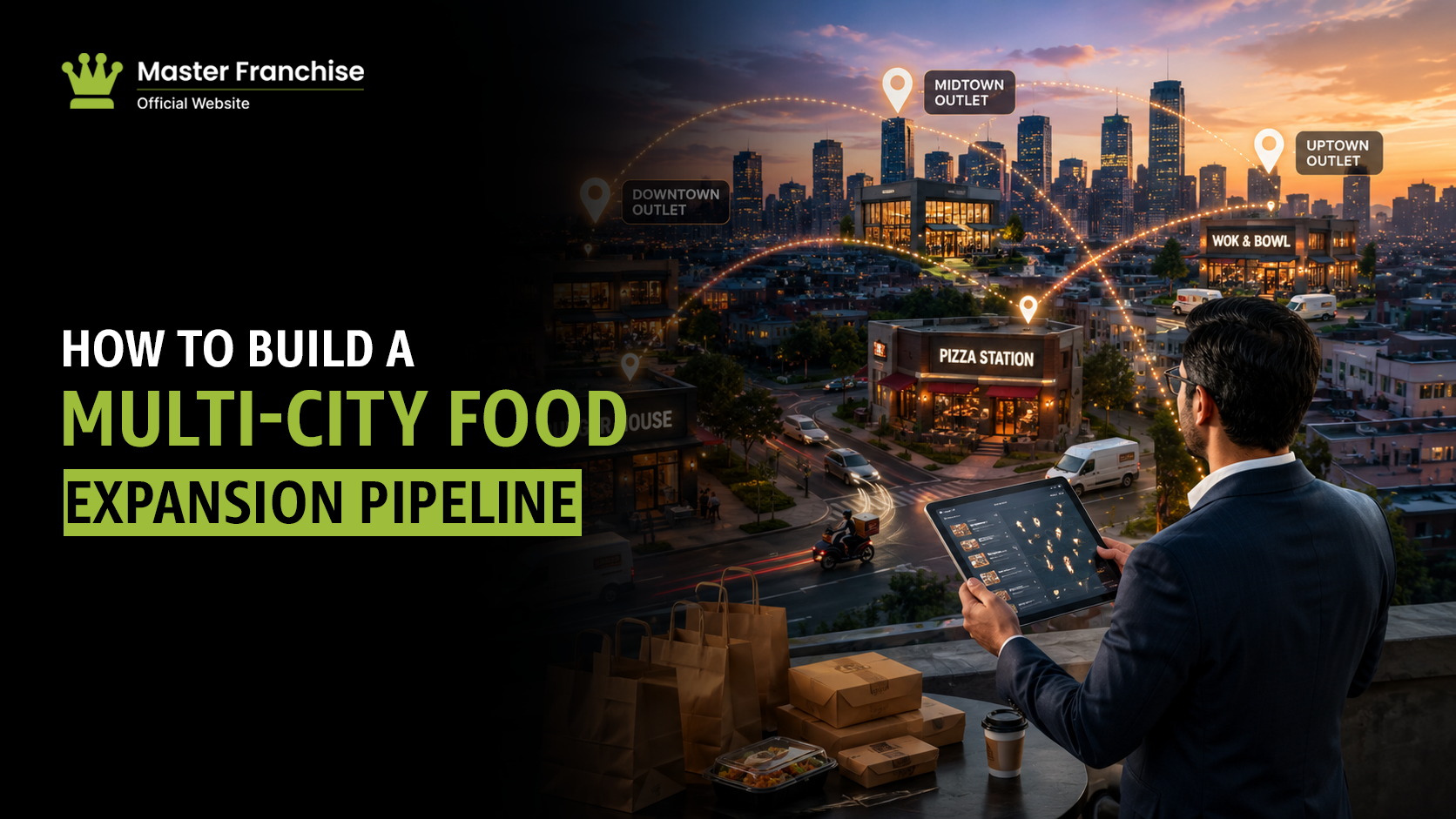
Most food brands think expansion starts with opportunity.
The strongest ones know expansion starts with pipeline design.
Opening one great location proves demand.
Opening across multiple cities requires structure, sequencing, and market
control.
Here’s how serious operators and territory owners build a multi-city food expansion
pipeline that scales cleanly, without overextending capital or operational control.
Table of Contents
- Define Your Expansion Criteria Before Your Next City
- Build Market Clusters, Not Random Dotsl
- Lock in Territory Strategy Early
- Standardize the Unit Model First
- Develop a Lead Pipeline for Operators, Not Just Customers
- Stage Cities by Priority and Timing
- Align Supply Chain Before Scaling
- Track Unit Economics Across Cities
- Protect Brand Consistency
- Design With Exit in Mind
- Frequently Asked Questions
1. Define Your Expansion Criteria Before Your Next City
Expansion should never be reactive.
Before adding a city, define:
- population density thresholds
- income demographics
- foot traffic requirements
- commercial lease benchmarks
- competitor saturation limits
If you can’t clearly explain why a city qualifies, it doesn’t belong in your
pipeline.
Discipline prevents dilution.
2. Build Market Clusters, Not Random Dots
Strong food expansion happens in clusters.
Instead of spreading across distant cities, focus on:
- regional density
- shared distribution
- shared marketing coverage
- shared leadership oversight
Clustering reduces:
- logistics complexity
- marketing waste
- management overhead
It increases:
- brand familiarity
- operational efficiency
- regional dominance
Markets compound better than scattered locations.
3. Lock in Territory Strategy Early
Before launching multi-city growth, decide:
- Will you retain corporate
control? - Use multi-unit operators?
- Grant area developer rights?
- Structure master franchise
territories?
Your territory structure shapes:
- speed of growth
- capital requirements
- operational involvement
- long-term exit optionality
Expansion without territory logic creates conflict later.
4. Standardize the Unit Model First
Multi-city expansion only works when:
- build-out specs are clear
- supplier relationships are
centralized - training systems are repeatable
- operating procedures are
documented - cost structures are predictable
If your first units still feel improvised, expansion will magnify problems, not
profits.
Stability first. Scale second.
5. Develop a Lead Pipeline for Operators, Not Just Customers
Looking for Proven Master Franchise
Opportunities?
Explore established franchise brands and learn how
experienced master franchisees have successfully developed regional and international markets.
Food expansion depends on:
- capital-ready operators
- experienced multi-unit partners
- regional developers
Your expansion pipeline should include:
- operator recruitment marketing
- investor qualification
- discovery processes
- financial vetting
Without an operator pipeline, the city pipeline stalls.
6. Stage Cities by Priority and Timing

Not all target cities should open simultaneously.
Create tiers:
- Tier 1: Immediate launch markets
- Tier 2: 6–12 month markets
- Tier 3: Future expansion markets
This prevents:
- capital strain
- management overload
- operational dilution
Controlled sequencing wins long term.
7. Align Supply Chain Before Scaling
Multi-city food growth stresses:
- ingredient sourcing
- logistics
- quality control
- vendor consistency
Before expanding, ensure:
- supplier contracts support scale
- distribution can serve new
markets - margins stay protected
Operational readiness protects brand reputation.
8. Track Unit Economics Across Cities
As cities open, monitor:
- cost variances
- labor differences
- rent ratios
- customer acquisition costs
- regional performance patterns
Multi-city expansion isn’t about copying and pasting, it’s about adjusting
intelligently.
9. Protect Brand Consistency
Rapid expansion can dilute identity.
Strong brands:
- maintain uniform branding
- standardize service experience
- enforce training protocols
- centralize marketing themes
Consistency builds long-term equity across markets.
10. Design With Exit in Mind
The strongest multi-city food pipelines are built for:
- regional consolidation
- private equity acquisition
- territory resale
- franchisor buybacks
Buyers pay premiums for:
- clustered markets
- scalable systems
- multi-unit operators
- clean reporting
Expansion without exit thinking leaves value on the table.
FAQs
Conclusion
Multi-city food expansion isn’t about opening more locations.
It’s about building:
- disciplined market criteria
- regional clusters
- structured territory strategy
- operator pipelines
- scalable systems
Explore Master Franchise
Opportunities
Connect with franchisors seeking experienced master
franchise partners for international and regional territory development.