For decades, quick service restaurants (QSR) have dominated the franchise growth landscape.
Large chain companies made thousands of standardized locations across the country, with the same menu offerings, drive-thru systems, and high-volume service.
But a different category has been blown up in the last few years:
Fast casual.
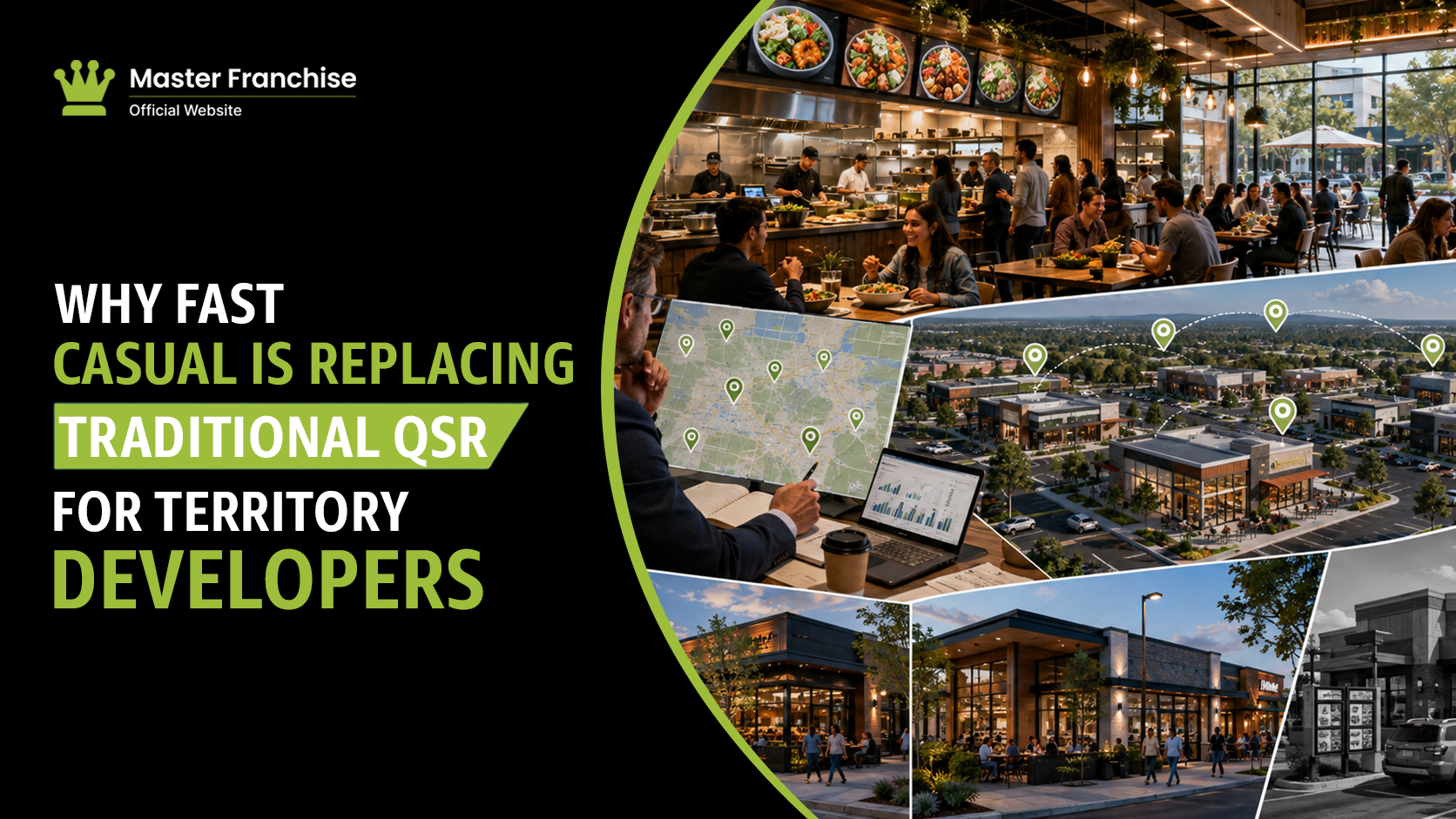
Fast casual concepts are fast emerging as the model of choice over traditional QSR models for territory developers and multi-unit franchise investors as they offer a unique combination of higher ticket size, smooth operations and superior positioned brand.
Table of Contents
Higher Average Ticket Sizes
The fast food restaurants compete largely on price.
Average ticket sizes are fairly small, in part because of value menus, discount promotions and intense competition.
In contrast, fast casual brands orbit around:
- higher-quality ingredients
- customizable menu options
- healthier choices
- modern dining environments
This will result in premium pricing from consumers.
This results in an increased average transaction value, which increases the potential overall revenues by location.
Simpler Menu Structures
Traditional QSR companies have big and complicated menus.
- That complexity requires:
- more kitchen equipment
- more staff training
- longer preparation processes
The typical fast casual menu will be based around a single core item like bowls, wraps, salads or signature dishes.
Simplified menus improve:
- operational efficiency
- food consistency
- staff training speed
- supply chain management
Simplified operations require fewer resources, enabling multi-unit growth for territory developers.
Smaller Real Estate Footprints
The average space needs for fast casual restaurants are smaller than traditional QSRs.
Many concepts require:
- no drive-thru
- limited seating
- simplified kitchen layouts
That decreases real estate cost and offers more options on locations.
Developers are able to cram multiple units into a given metro far more simply.
Looking for Proven Master Franchise
Opportunities?
Explore established franchise brands and learn how
experienced master franchisees have successfully developed regional and international markets.
Stronger Brand Positioning
Tastes in food have evolved for the consumer.
Options customers increasingly want to solve for:
- healthier
- fresher
- customizable
- more modern
These interests have good synergy with fast casual brands.
As a result, they tend to enjoy fierce brand loyalty among younger consumers and urban professionals.
Such a positioning unlocks brand scaling.
Easier Multi-Unit Scaling
Territory developers care about scalability.
The benefits of fast casual concepts generally include:
- shorter build-out timelines
- simplified operations
- manageable staffing requirements
- flexible site options
Those criteria allow investors to open multiple locations in a territory with greater speed.
Why Territory Builders Are Paying Attention
Even with the lasting strength of fast casual models, traditional QSRs (Quick Serve Restaurants) brands have a levelling factor between:
- strong revenue potential
- manageable operational complexity
- modern consumer appeal
These factors offer an attractive opportunity to investors seeking to develop multi-unit restaurant territories.
FAQ
Conclusion
Fast casual is eating QSR, but not all of it.
But it is reshaping the restaurant franchise landscape.
Fast casual concepts have opened a new door for scale-driven by bigger ticket sizes, more efficient operational structures, and flexible expansion models that create dynamic businesses for territory developers.
So, as consumers continue to evolve their preferences, especially in terms of convenience and healthfulness, fast casual will undoubtedly stay one of the more appealing sectors around when it comes to franchising opportunity as well as customer buy-in.
Explore Master Franchise
Opportunities
Connect with franchisors seeking experienced master
franchise partners for international and regional territory development.