Business almost across the board tends to slow in an unsettled economy.
Consumers reduce spending.
Businesses delay decisions.
Growth becomes harder to predict.
But some industries operate differently.
Senior care is one of them.
Senior care territories continue to stand out for master franchise developers (as well as multi-unit investors) demand being driven by:
- demographics, need and frequency of long-term care
Table of Contents
- No Way About It — Senior Care
- Demand: Do not Follow Follow the Trends, Follow the Demographics
- Recurring Care Provides Predictable Revenue
- Trust Creates Strong Retention
- Territory-Based Expansion Fits Naturally
- Flexibility Through Lower Infrastructure Requirements
- Economic crisis can bring a bigger demand
- Why Investors Are Watching
- The What: The Need for Basic Community Infrastructure
- Frequently Asked Questions
No Way About It — Senior Care
Economic slowdowns can cause families to postpone vacations or stopping discretionary purchases.
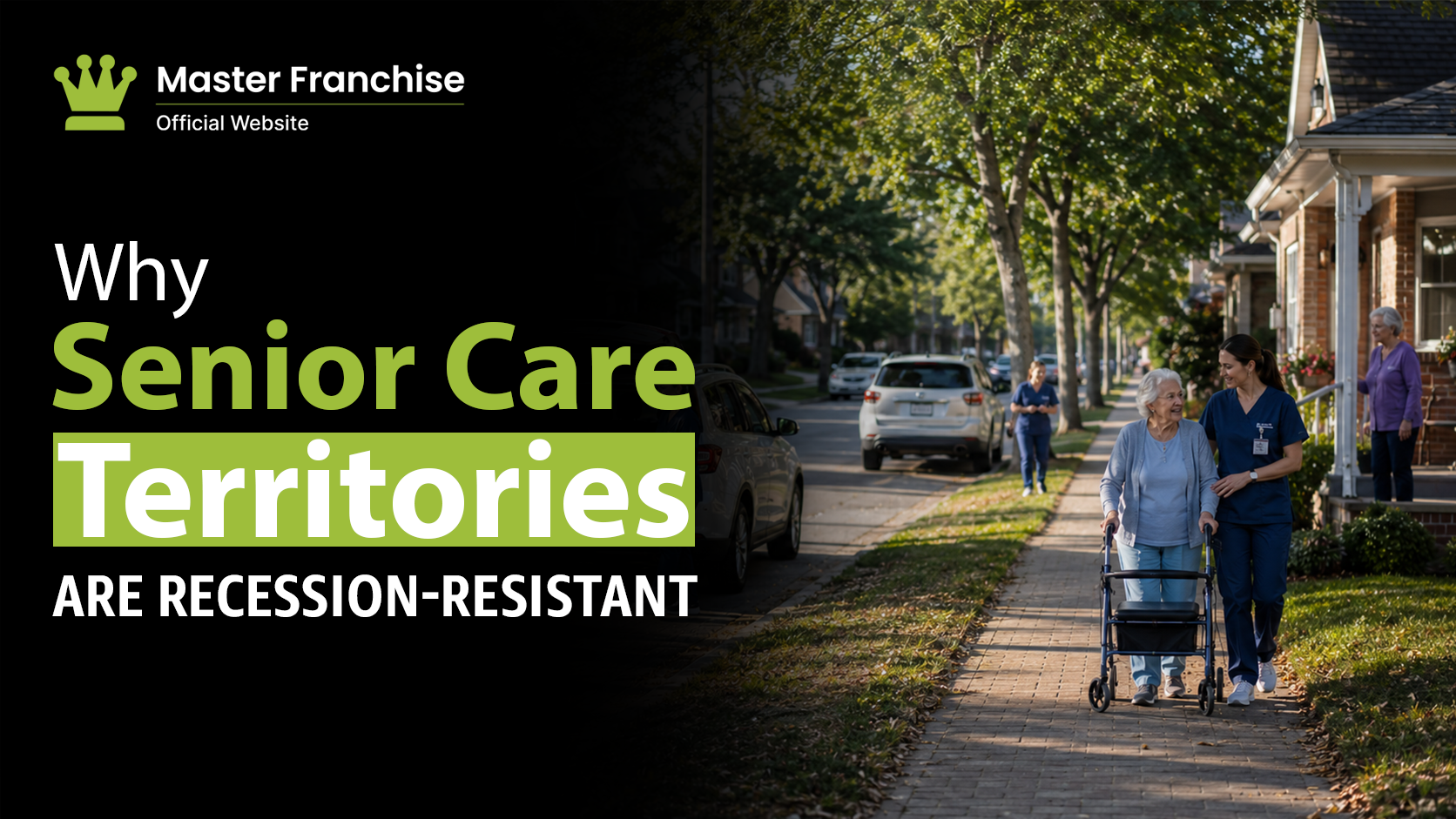
However, you cannot push back care for your ageing parents and loved ones.
Senior care services often involve:
- companionship
- daily support
- mobility assistance
- memory care support
- in-home care coordination
These needs are tied directly to quality of life.
Demand: Do not Follow the Trends, Follow the Demographics

A major benefit of senior care that is not a ploy to take advantage of trends.
It is demographic-based.
As populations age:
- care demand increases
- family support needs grow
They need support at home aid.
This leads to a long-term structural growth trajectory which is only slightly affected by economic cycles.
Recurring Care Provides Predictable Revenue
Senior care is rarely transactional.
Most clients require:
- recurring weekly care
- monthly service plans
- long-term relationships
This creates:
- predictable recurring revenue
- stable scheduling
- longer customer lifecycles
That improves visibility for cash flow and operational planning, especially for territory operators.
Trust Creates Strong Retention
Families are very picky when it comes to hiring a senior care services.
Under a value-based care model, once trust is established it becomes highly unlikely that a patient will choose to seek out alternative providers.
This leads to:
- high retention rates
- referral-driven growth
- long-term client relationships
Retention is an incredibly powerful economic moat in the category.
Territory-Based Expansion Fits Naturally
Senior care operates locally.
Families prefer providers who understand:
- the community
- local caregivers
- nearby service coverage
Which enables multi-unit and master franchise operators to construct:
- regional density
- local trust
- stronger operational efficiency
After all, a territory really sinks its teeth within the community over time.
Looking for Proven Master Franchise
Opportunities?
Explore established franchise brands and learn how
experienced master franchisees have successfully developed regional and international markets.
Flexibility Through Lower Infrastructure Requirements
Many of these senior care models scale without heavy infrastructure as opposed to large medical facilities.
Growth typically comes through:
- caregiver networks
- scheduling systems
- territory expansion
This often gives operators the opportunity to build in greater scalability, across different market.
Economic crisis can bring a bigger demand
It is funny how sometimes economic pressure can strengthen some segments of senior care.
Families may shift toward:
- in-home support
- instead of
- more expensive institutional care
It generates further demand for a territory based senior support services.
Why Investors Are Watching
Investors like senior care territories because they offer:
- recurring revenue
- demographic-driven demand
- strong retention
- recession resilience
- scalable territory growth
Such a franchise category is more defensive than anything driven by consumer trends.
The What: The Need for Basic Community Infrastructure
Senior care is a growing class of investment opportunities that sophisticated investors look at in unique ways.
Not just as a services company.
But as:
- community-based care infrastructure
The infrastructure of essential services is one of the few constants in the ever-changing and sometimes contradictory, economic situations.
FAQs
Conclusion
Senior care markets are relatively insulated from consumer trends and discretionary spending.
They are built around:
- demographic expansion
- recurring care needs
- trust-based relationships
- essential daily support
This is one of the toughest recession-resistant models available in franchising for multi-unit and master franchise investors.
Because in uncertain markets:
Luxury slows down.
Essential care continues.
Explore Master Franchise
Opportunities
Connect with franchisors seeking experienced master
franchise partners for international and regional territory development.