The majority of franchise categories in many industries rely on consumer choice.
Restoration businesses operate differently.
Customers do not wake up and say, oh, hey today you know what I want to do go purchase restoration services.
They have to call when something has not gone according to plan.
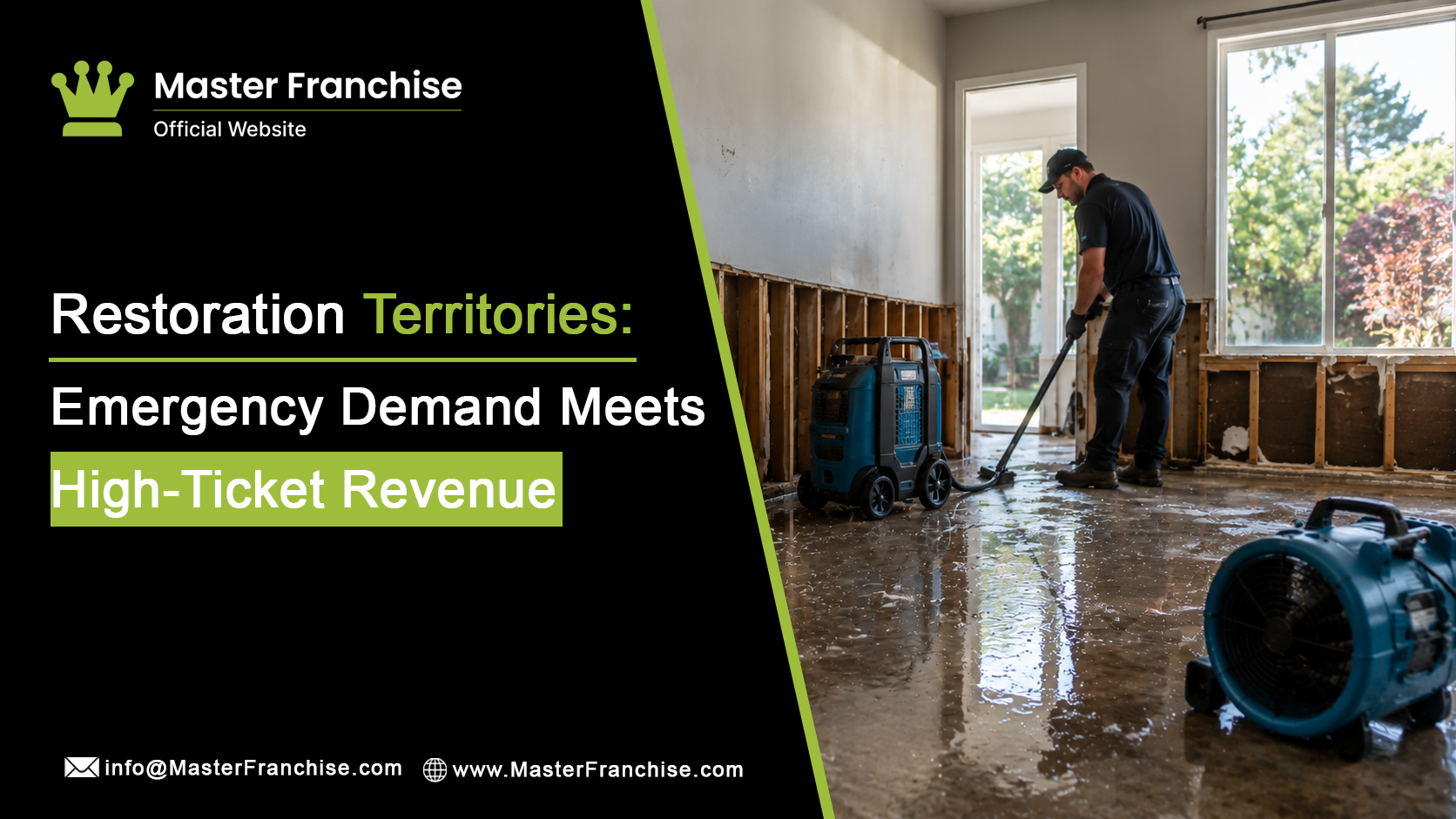
A flood.
A fire.
Storm damage.
Mold contamination.
Property emergencies.
And that in turn is exactly why they are so special for a master franchise developer or multi-unit investor.
They combine:
Direct clients with real need, projects that move the needle, and able to expand territory.
Table of Contents
- Demand Is Created by Needs
- High-Ticket Works Enhance Revenue Potential
- Restoration Work Is Linked To Insurance Claims
- Response Times Are Better With Higher Territory Density
- Revenue Expansion Opportunities With Commercial Clients
- Leverage The Multi-Unit Expansion
- Emergency Services Lead To Strong Market Positioning
- Why Investors Are Keeping Their Eyes Open
- A Real Opportunity: Regional Recovery Infrastructure
- Frequently Asked Questions
Demand Is Created by Needs
Unlike discretionary services, restoration work is rarely avoidable.
What Property Owners Must Have When Damage Occurs:
- immediate response
- professional remediation
- fast recovery
This creates urgent (not hopping on marketing trends) demand.
High-Ticket Works Enhance Revenue Potential
Many restoration projects have much larger transaction values than more conventional service businesses.
Projects can include:
- water damage restoration
- fire and smoke remediation
- mold removal
- storm recovery
- structural repairs
This means that a single project must be able to reap enormous revenue, allowing the model to become appealing from a territory perspective.
Therefore, you are bound to have the same opportunity every time through insurance relationships.
Restoration Work Is Linked To Insurance Claims
This creates a unique dynamic.
Because the loss event has already occurred, customers typically require the service regardless of broader macroeconomic conditions.
Some examples that generally develop network bonds to be strong restoration operators are:
- insurance professionals
- adjusters
- property managers
- commercial property owners
These relationships are capable of becoming repeat sources of leads.
Response Times Are Better With Higher Territory Density
In restoration, speed matters.
The quicker the company is capable of responding:
- the more damage that can be contained
- the greater the customer experience
- the bigger competitive edge
When operators have more density across a territory, the response capability improves dramatically.
Revenue Expansion Opportunities With Commercial Clients
Restoration isn’t limited to homeowners.
Commercial opportunities include:
- office buildings
- retail centers
- apartment communities
- warehouses
- healthcare facilities
Because commercial restoration projects increase job size and potential for long-term relationships.
Looking for Proven Master Franchise
Opportunities?
Explore established franchise brands and learn how
experienced master franchisees have successfully developed regional and international markets.
Leverage The Multi-Unit Expansion
There is support for robust cash flow generation in a single restoration area
A regional network creates:
- shared equipment resources
- centralized dispatching
- stronger brand awareness
- broader referral networks
- improved operational efficiency
It enables operators to scale more efficiently in a multi-market approach.
Emergency Services Lead To Strong Market Positioning
In a world for service businesses many times you compete on price.
Restoration businesses often compete on:
- response speed
- trust
- expertise
- reliability
In the order of urgent need, what happens is that customers stop shopping around and want a solution.
This shifts the customer acquisition economics.
Why Investors Are Keeping Their Eyes Open
Investors are drawn to restoration territories because they:
- emergency-driven demand
- high-ticket project values
- insurance-related lead flow
- scalable regional operations
- recession-resistant characteristics
This brings a special mix of profitability and urgency.
A Real Opportunity: Regional Recovery Infrastructure
Restoration is seen as a repair business for most people.
Place for sophisticated investors more considers:
property recovery infrastructure.
During these troubled times of disasters, everybody needs some trusted provider at the earliest.
Territory coverage: the operators that control a certain area can also become essential local resources.
FAQ
Conclusion
The territory of restoration is based on one troubling fact:
Problems will always occur.
Water damage.
Storms.
Fire.
Unexpected emergencies.
This results in a model for master franchise developers and multi-unit investors, which is based on:
- urgent demand
- high-value projects
- recurring referral relationships
- scalable territory expansion
Because in franchising:
One emergency creates a project.
A territory establishes a recovery net.
Explore Master Franchise
Opportunities
Connect with franchisors seeking experienced master
franchise partners for international and regional territory development.