Automotive services are not trend-based.
They are need-based.
Vehicles break down.
They require maintenance.
They require inspections, repair, cleaning, parts, and maintenance.
Hence, automotive territories continue to be of top interest for master franchise and multi-unit investors.
The opportunity isn’t solely running a single service center.
Instead, it is constructing a regional automotive service network around repeat consumer demand.
Table of Contents
- Automotive Demand Is Built In Throughout Vehicle Ownership
- Repeat Revenue Through Repair And Maintenance
- Territory Density Develops Competitive Advantage Locally
- Trust Drives Retention
- The Model Stands On Multiple Legs
- Fleet And Corporate Business Provides Stability
- Multi-Unit Expansion Creates Cost Efficiency
- Why Investors Are Watching
- The Real Opportunity Is In Creating Local Vehicle Service Businesses
- FAQ
Automotive Demand Is Built In Throughout Vehicle Ownership
All vehicles generate lifetime service requirements.
Consumers regularly need:
- Oil Changes
- Brake Service
- Tire Replacement
- Diagnostics
- Battery Replacement
- Engine Repairs
- Detailing
- Inspections
That need never goes away simply because consumer trends have changed.
Vehicle owners and operators are going to need automotive services for as long as they continue to own and operate vehicles.
That makes the category a lot steadier than many discretionary consumer businesses.
Repeat Revenue Through Repair And Maintenance
Automotive services are seldom one-time purchases.
A customer might be first for one, but then they may keep coming back for:
- Scheduled Maintenance
- Seasonal Service
- Unexpected Repairs
- Safety Checks
- Part Replacements
- Vehicle Upgrades
This creates repeat customer relationships.
Recurring service behavior invigorates revenue predictability and customer lifetime value for territory operators.
Territory Density Develops Competitive Advantage Locally
Automotive service is highly local.
As a rule of thumb, consumers generally gravitate towards providers that are:
- Nearby
- Trusted
- Fast
- Reliable
- Familiar
With multiple locations within a territory, the brand becomes more accessible and less ignorable.
Territory density can improve:
- Brand Awareness
- Customer Convenience
- Referral Activity
- Marketing Efficiency
- Repeat Visits
Here is where the power of multi-unit automotive ownership outshines that of a single location.
Trust Drives Retention
Automotive service is a category based on trust.
A common concern among many consumers is the fear of being overcharged or missold.
They often return for service down the road after finding a trusted provider,
That trust creates:
- Repeat Business
- Referrals
- Long-Term Customer Relationships
- Stronger Local Reputation
Trust entire territories that take on the issue of quality across services in automotive.
It is a revenue asset.
Looking for Proven Master Franchise
Opportunities?
Explore established franchise brands and learn how
experienced master franchisees have successfully developed regional and international markets.
The Model Stands On Multiple Legs

The automotive territories may have many revenue layers depending on the concept:
- Repair Services
- Maintenance Plans
- Detailing
- Tires
- Parts
- Fleet Services
- Memberships
- Commercial Accounts
Which provides operators with additional methods for monetizing the same customer base.
One customer might require a package of multiple plans over the duration of the vehicle.
Fleet And Corporate Business Provides Stability
In addition to individual consumers, automotive networks can offer service to:
- Local Businesses
- Delivery Companies
- Ride-Share Drivers
- Service Fleets
- Property Management Vehicles
- Small Commercial Operators
Fleet relationships help drive repeat service volume and more predictable scheduling.
This creates one more layer of territory value for multi-unit operators.
Multi-Unit Expansion Creates Cost Efficiency
A location can thrive with just one automobile.
It is economics that make the region more sustainable. There are two major ways a regional network does it:
- shared marketing
- centralized management
- technician training
- parts purchasing
- operational systems
- brand recognition
Larger networks allow operators to wield greater purchasing power and enhance operational consistency.
That is how features become scalable automotive territories.
Why Investors Are Watching
Automotive territories are attractive to investors because they offer:
- Essential Consumer Demand
- Repeat Service Needs
- Trust-Based Retention
- Multi-Location Scalability
- Commercial Account Potential
- Infrastructure-Level Demand
This creates a model based on need, not hype.
The Real Opportunity Is In Creating Local Vehicle Service Businesses
To most people, auto work is synonymous with repairs.
Sophisticated investors see something larger:
regional vehicle service infrastructure.
Every market has vehicles.
Every vehicle needs care.
Every customer needs a reliable provider.
The operator who builds a stout coverage of territory can become the default automotive service network within that locale.
FAQ
What are automotive territories?
Automotive territories are geographic markets assigned to target customers based on local demand and infrastructure.
How does infrastructure influence automotive consumer demand?
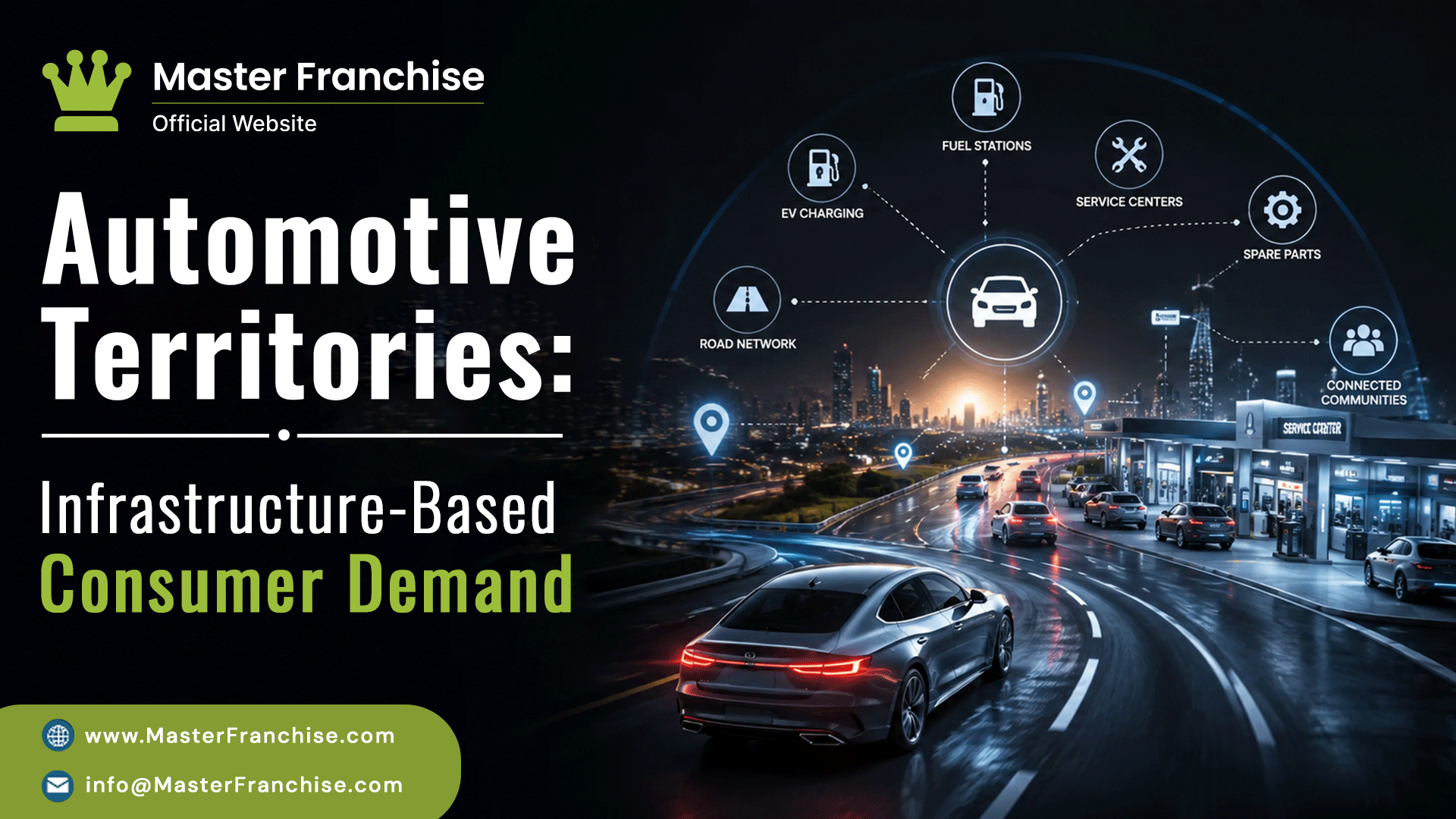
Road quality, population growth, charging stations, and transportation networks directly impact vehicle demand.
Why is territory planning important in the automotive industry?
It helps businesses allocate resources, improve sales coverage, and maximize market opportunities.
What are the benefits of infrastructure-based territory planning?
It improves market penetration, customer reach, sales efficiency and long-term business growth
Conclusion
Automotive territories fundamentally consisted of consumer demand based on infrastructure.
People might hold off buying that new car.
However, they still need to keep vehicles in service that they have on the road, which requires maintenance and repair.
This ultimately provides master franchise developers and multi-unit investors an unprecedented opportunity to establish regional networks that are built upon repeat service needs, customer trust, and density in the local market.
Because in franchising:
One repair creates revenue.
A territory builds the infrastructure of an automotive service center.
Explore Master Franchise
Opportunities
Connect with franchisors seeking experienced master
franchise partners for international and regional territory development.